Memorials › Gen David Flavel Jamison
Gen David Flavel Jamison
14 Dec 1810 – 14 Sep 1864
| Birth | 14 Dec 1810 |
| Death | 14 Sep 1864 |
| Cemetery | Presbyterian Cemetery Orangeburg , Orangeburg County , South Carolina , USA |
| Added by | David J. Rutledge on 06 Jun 2015 |
| FaG | https://www.findagrave.com/memorial/9192022 |
Bio
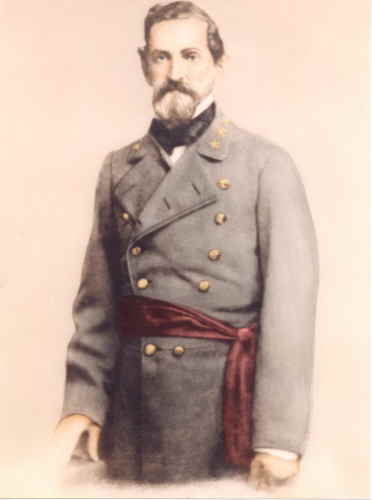
David Flavel Jamison, better known as "D.F." Jamison, was born Dec. 14, 1810 at White Hall Plantation in Orange Parish, South Carolina, U.S.A. (sometimes referred to as Orangeburg, Orangeburg District, S.C.). His parents were Dr. Van De Vastine Jamison and Elizabeth Rumph. Dr. Jamison was both a physician and a planter. The Jamisons were descended from Henry Jamison, who was born in Scotland and immigrated to the U.S. from the province of Ulster, Ireland to Philadelphia, Pennsylvania around 1730. The family name is sometimes spelled "Jameson" and there is another perhaps related variant, "Jamieson." D.F. went from Platt Springs Academy in Lexington District to the sophomore class in 1824 at South Carolina College, but did not graduate. Instead, he read law and was admitted to the S.C. bar in 1831. He practiced law until he married his cousin, Elizabeth Ann Carmichael Rumph on Dec. 11, 1832. Thereafter, he remained a planter, selling his plantation in Orangeburg and purchasing Burwell Plantation in the Barnwell District outside of Bamberg, S.C. A neighbor and good friend was the well-known southern author William Gilmore Simms. D.F. was also an author of many articles on history, in particular European history, published in the Southern Quarterly Review and elsewhere, such as Debow's Review , The Magnolia and The Southern and Western . He published one book, Life and Times of Bertrand Du Guesclin (2 volumes, London and Charleston, 1864), the manuscript for which had to have run the U.S. blockade both to and from London during the American Civil War. D.F. led an active political life in S. C., being first elected to the state House of Representatives from Orange Parish, Orangeburg District in 1836. He served there until 1848 and for most of those years was chairman of the committee on military affairs; this experience would serve him well during the Civil War. In 1848 he lost his seat to the outspoken secessionist Lawrence Massillon Keitt who went on to serve in the first Confederate Congress (regarding whom see William C. Davis' A Government of Our Own – The Making of the Confederacy , The Free Press, New York 1994. D.F. Jamison and his papers are referenced in this book, Note #131, pg. 425). By 1850 when he served as a delegate to the Nashville Convention, D.F. had become a firm secessionist himself, and he supported the "movement for separate action by South Carolina" in 1851 and 1852 (reference pgs. 604-5 of the Dictionary of American Biography, from which much of this narrative is derived). D.F. was elected to represent the Barnwell District of S.C. in the secession congress of 1860, and the convention elected him president of that body, on the fourth ballot, when it convened on Dec. 17, 1860. The unanimous (169-0) result issued at St. Andrew's Hall, Charleston, S. C. on Dec. 20, 1860, was the Ordinance of Secession of South Carolina. (For the full text of this historic document, please see www.csawardept.com/documents/secession/SC/.) D.F. considered this the crowning event of his life. He further served South Carolina from that December until April 1861 as a member of the Executive Council. In December 1862, D.F. was appointed Presiding Judge for the Military Court of P. G. T. Beauregard's Army Corps. He continued this service until his death, most likely of Yellow Fever, on September 14, 1864, at Charleston, S. C. His body was removed to Orangeburg, South Carolina and buried among some of his children who proceeded him in death. The following quote comes from a document titled Mrs. Carmichael's Tale of the War : " By David Jamison Rutledge. "In August my husband was sent to Tallahassee, where he had to stay for some weeks. In that town a fatal fever was prevailing to a great extent. On his return, he came home for one day. The day he returned to his duties in Charleston, he was taken sick with a fever similar to that in Tallahassee, and in ten days he was gone. I did not know of his illness until it was all over." When General Sherman passed through Orangeburg, he let it be known that because D. F. Jamison was the President of the South Carolina Secession Convention, if the grave of Jamison where found, his body would be exhumed and burned upon a pyre with the family and ex-slaves being forced to watch. His daughter, Caroline Jamison Jenkins, upon hearing of this through the former slaves, came to Orangeburg, and with the help of two men, exhumed her father's body, placed the coffin on a wagon and reburied it in a swamp close to Charleston, South Carolina. His remains were later returned to Orangeburg and buried in their original location. The memorial above his grave was erected by his friends in 1897. I
Inscription
General David Flavel Jamison Soldier Statesman Scholar Erected by his friends _________________________ Born in Orange Parish; December 14, 1810 Died in Charleston September 14, 1864 President of the Secession Convention
Photos




Family
Parents
Spouse
Siblings
- Mary Ann Jamison Dwight 1799–1868
- Jacob Rumph Jamison 1801–1809
- Van de Vastine Jamison Jr 1803–1806
- Caroline Elizabeth Jamison Glover 1805–1856
- Van de Vastine Samuel Jamison 1808–1876
- Elizabeth Margaret Jamison Tyler 1814–1871
Children
- David Rumph Jamison 1834–1908 FaG
- Caroline Harper "Carrie" Jamison Jenkins 1837–1902 FaG
- Lieut John Wilson Jamison 1839–1886 FaG
- William Harper Jamison 1841–1887 FaG
- Robert Van De Vastine Jamison 1843–1856 FaG
- Sallie Preston Jamison Wilson 1846–1894 FaG
- Mary Dwight "Mamie" Jamison Breese 1847–1904 FaG
- Elizabeth Rumph "Bessie" Jamison 1849–1930 FaG
- Flavel Jamison 1851–1852 FaG
- Thomas Worth Jamison Sr 1853–1924 FaG
- Flavel Deliesseline Jamison 1855–1856 FaG
- Clara Felicia Jamison Williams 1857–1942 FaG
Export GEDCOM
This person only · Entire connected family